
The Hydra still lifts, but the boom pauses halfway. The steering feels heavier than last month. There is fresh oil near a cylinder pin.
None of these should wait for the machine to stop completely.
A Hydra or pick-and-carry crane works under load, travels around active sites and often spends long hours in dust and heat. Workshop repair should cover the fault that brought it in, but it should also look for damage that can affect the next lift.
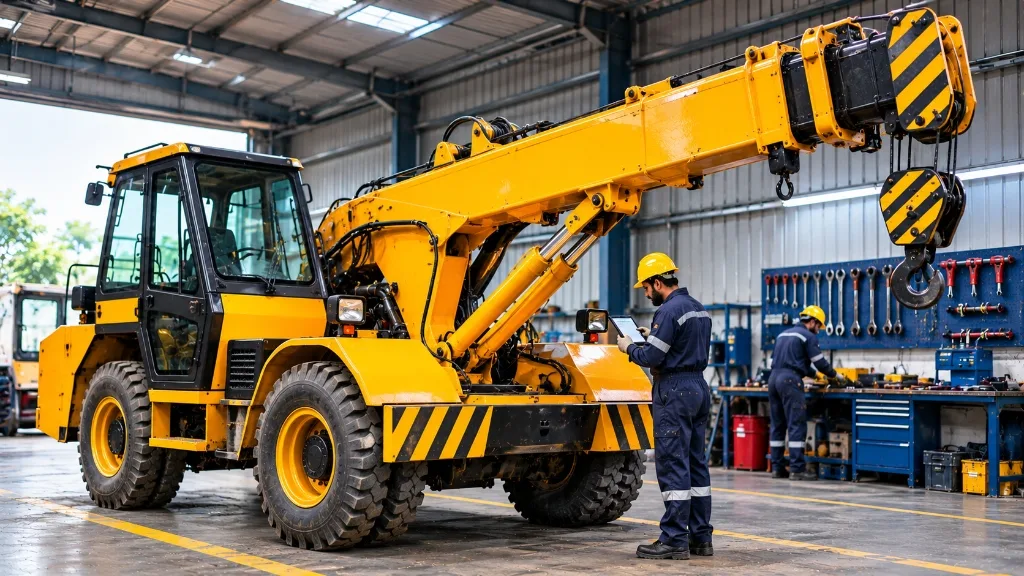
Start with the machine’s exact identity
“Hydra” is used as a common name for many pick-and-carry cranes. The workshop needs the manufacturer, model, serial number, rated capacity and configuration. Parts, pressure settings, load information and inspection procedures can change between models.
Send the hour reading, operator complaint, fault-code photo and any recent repair details. If the problem appears only with a load or after the oil gets hot, say so.
The boom deserves more than a paint check
Clean the boom before inspection. Mud and grease can hide cracks, damaged weld areas, loose fasteners and pin movement.
The workshop should inspect boom sections, pivot areas, cylinder mounts, pins, bushes, wear pads and hose routing. Any structural concern needs assessment against the manufacturer’s repair procedure. Welding an extra plate over a crack without understanding why it formed may move the stress somewhere else.
Hydraulic checks should follow the symptom
An oil leak does not prove that the pump is weak. A boom that will not hold may point towards a cylinder, valve or internal circuit leakage. Slow movement across every function suggests a different path from one slow cylinder.
Useful workshop checks may include oil condition, filters, visible leakage, hose damage, cylinder drift, temperature, pressure and function timing. The exact method and permitted readings should come from the model’s service information.
Ask the workshop to show which test supports a pump, valve or cylinder repair. Parts should not be chosen by guesswork.
Steering, brakes and tyres are part of crane safety
A pick-and-carry crane does not work only when stationary. Steering play, uneven braking, damaged tyres and wheel fasteners affect travel and positioning. These checks matter even if the complaint was hydraulic.
The operator controls, emergency functions, warning devices and capacity or load indicators fitted to that model also need functional checks. A safety device that keeps tripping should be diagnosed. It should not be bypassed to finish a job.
Ask what will be tested before release
The workshop should carry out function tests after repair and record the findings. Any load test or formal certification must be handled by the appropriate competent person and according to the applicable machine and legal requirements. A normal workshop run is not a substitute for statutory inspection.
Request a written job card showing:
- Complaint and diagnosis
- Parts repaired or replaced
- Oil and filter work
- Safety-device checks completed
- Outstanding defects
- Test performed before delivery
Liebherr’s crane maintenance training separates general service work, inspections, diagnostics, brake systems and model-specific service information. The same principle applies here: crane work needs crane knowledge. General diesel-mechanic experience alone is not enough.
Should the Hydra go to a workshop?
Minor diagnosis and accessible repairs may be handled on site. Move the machine to a suitable Hydra workshop when the job requires clean hydraulic dismantling, structural assessment, machining, major cylinder work or controlled testing.
Before transport, confirm boom stowage, machine dimensions, tyre condition and safe loading arrangements. Do not move an unsafe crane merely because the workshop is nearby.
Complete Hydra Crane Workshop & Repair Services
- Hydraulic pressure, leakage and cylinder-drift diagnosis
- Boom, pin, bush, wear-pad and structural inspection
- Wire-rope, sheave, hook and winch checks
- Steering, brake, axle and tyre inspection
- Electrical controls, warning devices and interlock diagnosis
- Outrigger and stability-system checks where fitted
- Repair documentation and coordination of required inspection
Why Choose Mech On Site for Hydra Crane Requirements?
Hydra repairs need both machine diagnosis and a clear lifting-safety boundary. Mech On Site enables customers to share crane configuration, fault history and site details before a repair requirement is assessed.
Repair support does not replace a statutory or manufacturer-required inspection. Any certification or return-to-service decision must be completed by the appropriately competent or authorised party.
Frequently Asked Questions
1. Can a Hydra crane with boom drift continue working?
It should be removed from lifting service until the cause is assessed. Drift may involve a cylinder, holding valve, control valve or leakage elsewhere in the circuit, and the permitted movement depends on the crane procedure.
2. What information is needed for a Hydra repair request?
Provide the manufacturer, model, rated capacity, configuration, hours, site location and exact symptom. Include safe photographs of the boom, rope, hook, outriggers, tyres and visible leakage.
3. Is hydraulic repair enough to return a crane to service?
Not by itself. The repaired function needs testing, and any required crane inspection or certification remains a separate responsibility.
4. When does a Hydra need workshop repair instead of field repair?
Workshop work is usually appropriate for cylinder rebuilding, clean hydraulic dismantling, machining, major winch work or approved structural repair. Accessible hoses, wiring and initial diagnosis may often be handled at site.
5. Can a temporary crane be arranged while mine is repaired?
A rental requirement can be submitted with the capacity, reach, site access, dates and lift conditions. The replacement crane must be selected from its load chart and actual configuration. Nominal capacity alone is not enough.
Mech On Site recommendation
Mech On Site recommends removing a Hydra crane from lifting service whenever boom drift, rope damage, unreliable steering or a possible structural defect is observed. Completion of a hydraulic repair should not be treated as confirmation that the crane is ready to return to lifting operations.
For the initial assessment, please provide the crane model, rated capacity, working configuration, operating hours and site location. Photographs of the rope, hook, boom, outriggers and visible leakage are useful, while videos should be recorded only when this can be done safely.
Diagnosis and repair should be scoped separately from any statutory inspection or certification. Where such inspection is required, it must be completed by a competent and appropriately authorised person in accordance with the applicable rules.
Related Mech On Site services
For crane requirements, Mech On Site accepts enquiries for fault diagnosis, repair coordination, equipment inspection, spare parts and suitable mechanic support. Inspection and certification remain separate activities and must be completed by the appropriately competent or authorised party.
Customers may also submit rental requirements for a Hydra or another suitable lifting machine when temporary replacement capacity is needed. Owners with an available crane can submit it through the equipment-listing service.