
A microtunnelling machine cannot be treated like a general excavator sent for routine repair. The machine, ground conditions, drive length, pipe size, slurry arrangement and guidance system work together. A fault in one area can appear as a problem somewhere else.
Before the machine is moved, record the exact machine model, installed cutterhead, drive history, operating hours and the conditions in which the fault appeared. Save alarm codes, control-screen photographs, slurry pressures, jacking loads and operator notes where available. These details are often more useful than a general statement such as "the machine is not cutting properly."
Start with the drive symptoms
The workshop or specialist should know what changed during operation. Useful questions include:
- Did cutterhead torque rise suddenly or gradually?
- Did advance rate fall while jacking force increased?
- Was slurry pressure unstable?
- Did the guidance system show repeated deviation?
- Was there unusual vibration, heat, noise or leakage?
- Did the fault begin after a stoppage, tool change or ground transition?
This first record helps separate a cutting problem from a bearing, seal, slurry, guidance or hydraulic problem.
Inspect the cutterhead and cutting tools
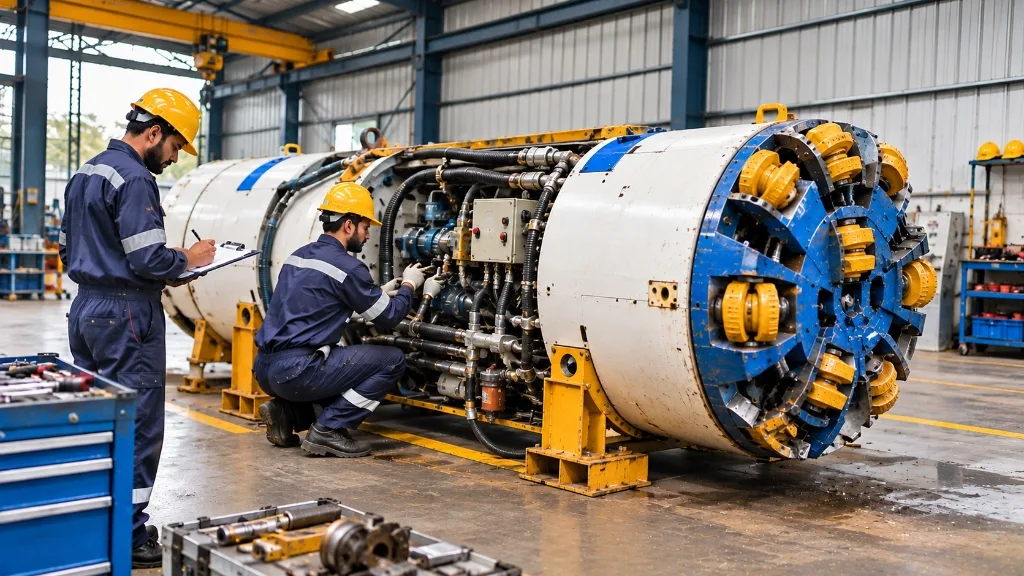
The cutterhead should be inspected for worn or missing tools, damaged holders, blocked openings, uneven wear and material packed around the face. The correct inspection depends on the machine design and the ground for which the cutterhead was configured.
Do not apply a universal wear limit. Tool type, access method and replacement criteria must come from the machine documentation and the approved project procedure.
Main bearing and seals need specialist attention
Oil leakage, slurry ingress, abnormal temperature, metal contamination or unusual movement around the main bearing area deserves immediate investigation. Replacing a seal without finding why it failed may only delay the next stoppage.
Ask the repair team how they will check lubrication, contamination, sealing surfaces, bearing condition and any permissible movement. Measurements should be compared with the manufacturer procedure for that machine.
Check the slurry circuit as a complete system
Poor excavation performance may come from blocked lines, worn pumps, damaged valves, incorrect slurry properties or a separation plant that cannot handle the returning material. Check the feed and return circuit, pumps, hoses, valves, sensors and separation equipment together.
The workshop should also inspect components for abrasive wear. A pump can still run while its performance has fallen enough to affect face control and spoil removal.
Guidance and control faults need recorded data
Guidance problems should not be reduced to changing a sensor at random. Inspect the target, laser setup, reference points, cables, connectors, communication network, steering cylinders and control inputs. Confirm that calibration and alignment follow the project procedure.
Electrical cabinets, connectors and cables should be checked for water, damaged insulation, loose terminals and heat marks. Hydraulic circuits should be checked for leakage, contamination, pressure loss and cylinder drift using the machine-specific method.
Include the jacking system and backup equipment
The main jacking station, intermediate jacking stations, thrust ring, cylinders, hoses and controls are part of the same operation. Uneven cylinder movement or incorrect load information can affect alignment and pipe loading.
Backup equipment also matters. Pumps, power packs, ventilation, communication and separation equipment should be included in the repair scope where they contributed to the stoppage.
Decide what can be done on site
Sensor checks, hose replacement, electrical tracing and some hydraulic diagnosis may be possible at the project. Major bearing, seal, cutterhead or structural work may need controlled workshop facilities, lifting arrangements and specialist tooling.
Complete Microtunnelling Machine Repair Services
- Cutterhead and cutting-tool inspection
- Main-bearing, seal and lubrication assessment
- Slurry pump, valve, line and separation-system checks
- Guidance, steering and control-system diagnosis
- Hydraulic, electrical and communication-system work
- Main and intermediate jacking-station inspection
- Specialist field assessment, workshop scope and parts requirements
Why Choose Mech On Site for Microtunnelling Requirements?
An MTBM fault must be reviewed with drive data, ground condition and machine configuration. Mech On Site allows project teams to submit this information together when seeking specialist diagnosis, workshop coordination, parts or manpower.
Final provider suitability, engineering decisions, repair procedure and return-to-drive approval remain subject to the manufacturer information and project method.
Frequently Asked Questions
1. What data should be saved before an MTBM is moved?
Preserve jacking loads, cutterhead torque, advance rate, slurry pressures, guidance history, alarm logs and the ground condition at the failure point. This data may be lost after dismantling.
2. Can microtunnelling repairs be completed at the shaft?
Sensor, wiring, hose and some hydraulic work may be possible at site. Main-bearing, seal, cutterhead and structural work may require controlled facilities, lifting arrangements and specialist tooling.
3. Why should the slurry system be checked with the machine?
Blocked lines, worn pumps, valve faults or poor separation can reduce excavation performance and affect face control. A cutterhead complaint may therefore involve the wider slurry circuit.
4. What should a specialist repair proposal include?
It should separate site diagnosis, dismantling, measured inspection, parts, workshop work, testing and return-to-service documentation. Engineering assumptions should identify the machine configuration and ground conditions.
5. Can I request project-based specialist manpower?
A project may submit a requirement with the MTBM model, drive stage, location, shift pattern and expected duties. Specialist experience, mobilisation and engagement terms require confirmation.
Mech On Site recommendation
Mech On Site recommends preserving the operating data before an MTBM is moved or dismantled. Jacking loads, cutterhead torque, advance rate, slurry pressures, guidance history, alarm logs and the ground condition at the point of failure can all influence the diagnosis.
The service request should identify the exact machine and cutterhead configuration, pipe diameter, drive length, current chainage and fault history. A specialist assessment should clearly separate work that can be completed at site from work requiring controlled workshop facilities.
Decisions involving the main bearing, seals, guidance system or structure must follow the manufacturer’s procedure and the project’s approved method statement.
Related Mech On Site services
Microtunnelling projects can submit requirements through Mech On Site for specialist diagnosis, workshop coordination, component inspection, spare-parts support and project-based mechanic requirements. The exact MTBM configuration and project data are necessary before the scope can be assessed.
Where additional equipment or temporary project capacity is required, customers may also submit a rental enquiry. Owners or contractors with suitable available equipment can use the equipment-listing service.