
“Pump weak” is not enough information for a pump repair.
Which pump? What fluid? What pressure and flow were expected? Did the output fall suddenly or slowly? Was there noise, heat, leakage or contamination? A workshop needs the system story before it strips the component.
This article focuses on hydraulic pumps used in construction and industrial equipment. Water, fuel, slurry and process pumps need different test methods.
Confirm that the pump is actually at fault
Low system pressure can come from a worn pump. It can also come from a relief valve that is open or set incorrectly, a blocked suction path, low oil level, unsuitable oil, internal leakage elsewhere or an engine that cannot drive the pump at the required speed.
Parker’s troubleshooting information lists low pump output and relief-valve problems as separate causes of low pressure. That distinction matters. Rebuilding a healthy pump does not close a leaking valve.
Ask for pressure, flow, case-drain or other model-appropriate tests before removal where possible. Record whether performance changes as the oil heats up.
Send the plate details with the pump
Photograph the manufacturer plate and part number before transport. Mark the ports and rotation direction. Cap every opening.
The workshop should know:
- Machine and pump model
- Operating fluid
- Fault symptoms
- Available test readings
- Oil and filter condition
- Recent hose, valve or pump work
- Whether another component failed in the same circuit
A pump arriving open to dust in the back of a vehicle already has a new problem.
What a proper strip inspection includes
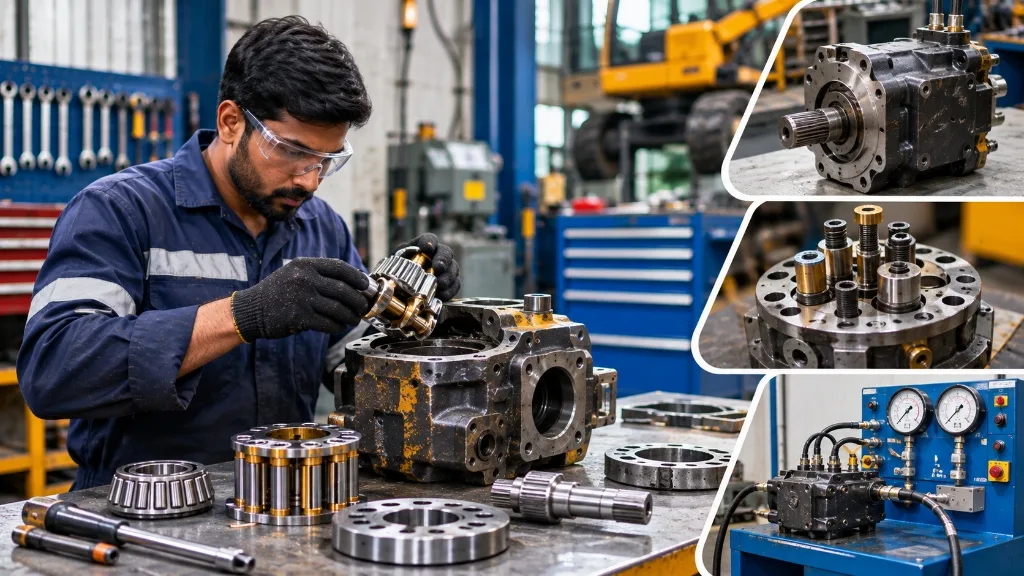
The exact parts depend on pump design. The workshop may need to inspect shafts, bearings, rotating groups, gears, vanes, pistons, control parts, housing surfaces and seals. Reuse decisions should be based on measurements and the service specification.
Ask which hard parts are worn and how the workshop measured them. A seal kit can stop an external leak, but it cannot restore worn pumping clearances.
Contamination patterns can also point back to the system. Hard particles, water, wrong oil and overheating all leave different clues. The cause needs attention before the repaired pump returns to service.
Pump repair near me: what matters more than distance
A nearby workshop reduces transport time. It still needs:
- A clean dismantling and assembly area
- Correct measuring tools
- Access to service data
- Traceable parts
- A suitable test bench or a clear post-installation test plan
- A written report and warranty scope
Ask whether the workshop repairs this pump design regularly. “All hydraulic pumps” is a broad claim.
Rebuild or replace?
Rebuild when the main housing and hard parts are serviceable, correct parts are available and the result can be tested. Replace when damage is extensive, the housing is cracked, key parts are obsolete or repeated earlier repairs have left no reliable repair route.
Price alone should not decide. Add the risk of another removal, fresh oil, filters, transport and machine downtime.
Refit is part of the repair
Before fitting the pump, check why it failed. Flush or clean the system as required by the manufacturer, replace affected filters and confirm that coolers, suction lines, breathers and relief settings are correct. Use the specified oil.
Start and commission the system according to the machine procedure. Watch noise, temperature and leakage. Record the final readings.
Complete Hydraulic Pump Repair Services
- Machine-side pressure and flow diagnosis
- Pump dismantling and internal inspection
- Measured wear and clearance assessment
- Bearing, seal and rotating-group replacement requirements
- Housing and surface-condition checks
- Bench testing and test-record requirements
- Circuit cleaning, refitting and commissioning support
Why Choose Mech On Site for Pump Repair Requirements?
A pump repair request should include evidence from both the component and the machine circuit. Mech On Site allows customers to submit the pump plate, machine details, symptoms and oil or filter findings before workshop work is planned.
Repair feasibility, parts, machining, bench-test criteria and warranty remain subject to inspection by the selected provider.
Frequently Asked Questions
1. How do I know whether the pump is actually faulty?
Low pressure alone does not prove pump failure. Relief valves, suction restriction, internal leakage, control signals and engine speed can produce similar symptoms, so pressure and flow diagnosis should come first.
2. What does a pump workshop inspect?
The workshop may inspect bearings, seals, shafts, housings, valve plates and rotating parts according to the pump design. The report should include measured findings rather than only a replaced-parts list.
3. Should the hydraulic system be cleaned after pump failure?
Yes, where contamination or internal damage is present. Filters, tank, cooler and affected lines may need cleaning or replacement according to the machine procedure before a repaired pump is installed.
4. Can every hydraulic pump be rebuilt?
No. Severe housing damage, unavailable parts or repair cost may make replacement more sensible. The decision depends on inspection results, component availability and the value of a tested repair.
5. What should I ask for before accepting the repaired pump?
Request the job report, parts list, bench-test record and warranty terms. Also confirm who will commission the pump and check system settings after installation.
Mech On Site recommendation
Mech On Site recommends approving a pump rebuild only after the workshop has identified the internal wear and investigated the cause of failure. A rebuilt pump can be damaged again if it is returned to a system with contaminated oil, suction restriction or an unresolved relief-valve fault.
Please provide the pump identification plate, machine model, operating hours, hot and cold symptoms, oil condition and filter findings with the service request. The repair proposal should include measured inspection results, the intended parts replacement and the final bench-test record.
Responsibility for cleaning the hydraulic circuit, replacing affected filters and commissioning the pump on the machine should also be agreed before refitting.
Related Mech On Site services
Mech On Site accepts requirements for hydraulic diagnosis, pump and component repair, inspection findings, spare parts and mechanic support. Providing the pump plate and machine details helps separate a component requirement from a wider hydraulic-system fault.
If the machine cannot return to work immediately, customers may also enquire about replacement equipment on rent. Machine owners can submit available equipment through the rental-listing service.